Hanakai
An ikebana gathering, carrying a centuries-old tradition into the present.
Convened by LILY|理々
花会 [ hana-kai ]
The Metropolitan Museum of Art · Public Domain · View source ↗
The Metropolitan Museum of Art · Public Domain · View source ↗
Hanakai takes its name from 花会 — hana-kai, a gathering around flowers.
Ikebana is often understood simply as the art of arranging flowers. It is that—and also a way of seeing, shaped over centuries and still practised today.
In Japan, ikebana has taken many forms across life — from temple offerings to court gatherings to the quiet of an ordinary home. Hanakai carries that same attention into a single gathering.
Hanakai does not recreate any single era or ceremony. What it inherits is the idea beneath them — people gathering around flowers, arranging, viewing, and sharing the same time and space. That idea is reopened here, today.
Hanakai is not a cultural tour. It is not a wellness retreat. What sits at its centre isn't healing — it's attention.
To ikeru is to read the life and character already present in a material, and — through a sequence of choices — bring flower, vessel, water, empty space and setting into a single, coherent scene.
-
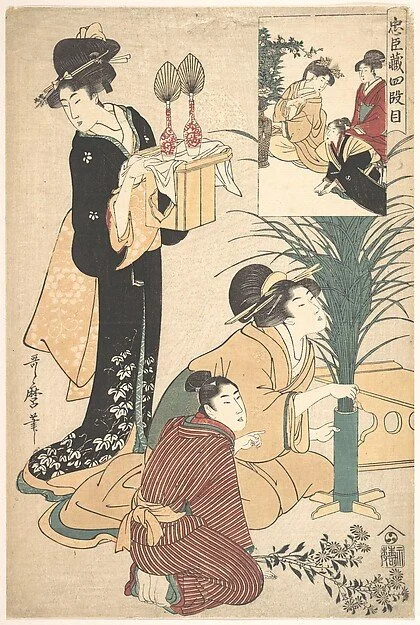
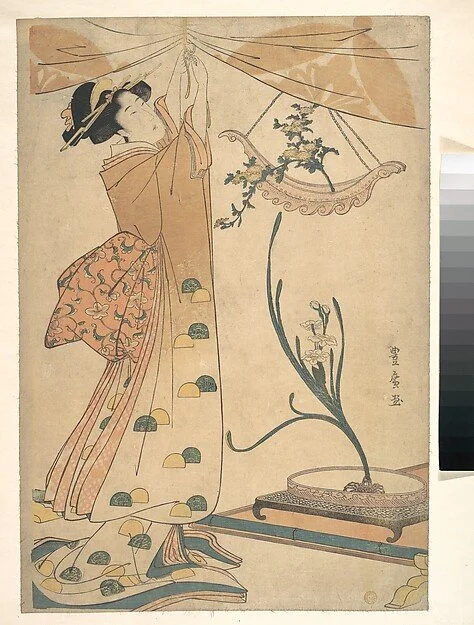
Formal gatherings around flowers trace back centuries in Japan. In the halls of Muromachi-era nobility, flowers were arranged and viewed together as hana-go-kai. By the early Edo period, similar gatherings — tatehana-no-kai — were held at court and noble residences. Around Emperor Go-Mizunoo's court, these gatherings were convened frequently with the master Ikenobo Senko, drawing together nobility, samurai, monks and townspeople in a single cultural space. Over time, the practice reached ordinary townspeople too, changing shape with each era, each community, each way of living. Seeing beauty. Reading what a material already holds. Choosing. Letting go. Finding and shaping relationship. Working with what is left empty. Seeing where your eye differs from someone else's. Stillness and focus aren't something Hanakai promises. They are what a precisely designed experience tends to produce.
Ikebana comes from ikeru—to give life to flowers.
At Hanakai, ‘ikeru’ is not about following a formula.
It is a process of seeing, choosing and responding to the materials in front of you.
LILY distills the practice of ‘ikeru’ into five guided movements.
SEE SELECT CUT RELATE SAVOUR
IKERU
What you leave with
A WORK
One ikebana piece, shaped entirely by your own choices.
A DEEPER SENSIBILITY
The flower does not change. What you receive from it does.
A MASTER'S EYE
Direct guidance from an Ohara ikebana artist, working with you alone.
Your work, seen for one afternoon among others — arranged this way only once, by no one else.